
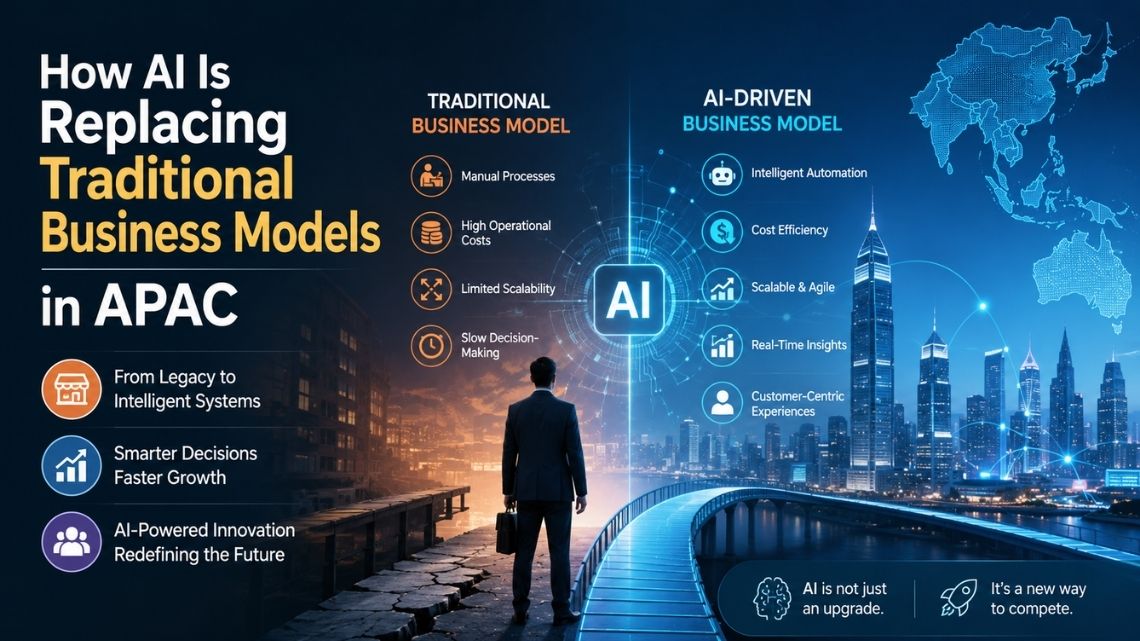
AI leapfrogging is transforming how businesses in the APAC region perceive corporate value creation, workflow design and foundational infrastructure. AI driven business model transformation fundamentally refers to a holistic restructuring of both structural and functional organizational frameworks such as core operations, revenue strategies, data ecosystems into adaptable and cutting edge AI systems. Amidst the rising complexity and rivalry in the APAC landscape, AI in business is indispensable for organizations to cultivate predictability, operational agility and organizational maturity.
Why Is AI Transforming Traditional Business Models in APAC?
According to APAC Entrepreneur, there are different catalysts behind the growing transformation of business models initiated by AI technologies.
- Rising Digital Adoption
Cloud solutions, mobile online shopping, digital payment systems, and other connecting technologies allow for the creation of a foundation for applying AI technologies in functions and customer journey of companies.
- Growing Demand for Personalization
The consumer economy is more gravitated toward brands that understand their preferences. AI innovation in this enables organizations to hyper personalize recommendations, customer services, content delivery, and cultivate engagement at scale.
- Pressure to Improve Operational Efficiency
Automation using advanced AI helps humans relieve from repetitive processes, intelligent autonomous agents help accelerate decision velocity, and detect deviations from the norm.
- Expansion of Data-Driven Business
With the help of AI, it is possible to utilize the information received from business operations to promote business.
- Increasing AI Investment
Due to intensified investments aimed at the development of AI technologies in the business sphere, companies can develop and test new products and business solutions.
How Is AI Replacing Traditional Business Models Across APAC?
APAC Entrepreneur highlights the architectural shift AI is introducing by transforming linear, physically intensive and reactive models in this region.
- From Physical Expansion to Intelligent Platforms
The legacy expansion playbook requires organizations to establish several physical offices, hire an increased number of local workforces and implement on-premise infrastructures. With the integration of Ai, organizations are able to scale border free without necessitating physical offices or local management layers. Platform based AI tools help connect the buyers, internal as well as external stakeholders and vendors within a unified ecosystem. AI makes enterprise scaling streamlined, as it shifts the paradigms of business operations and growth from physical expansion to intelligence-driven.
- Process Automation via AI Agents
Traditional automation functioned with a fixed set of rules. However, AI enables rather complex operations, including data processing, action planning, decision making and multi step task performance independently. and businesses can apply AI in the domains of customer service, cross border trade documentation, back office workflows, research, helping to reduce reliance on IT and overhead cost.
- Hyper-Personalization and Agentic Commerce
AI helps offer personalized experience according to the customers’ behavior and intentions.
Agentic AI commerce goes beyond task automation, it can be integrated for sales pitch, customer support, conversational conversion, providing customers personalized brand experience. Multi language commerce bots are effective in managing regional communication transactions. Competitive differentiation in markets like APAC cannot be achieved through diversity in service or product but a better digital interface for customers.
- Localized and Hybrid Infrastructure
APAC countries do not represent a uniform market with respect to technologies. Each country has its own regulations, languages, infrastructure, data requirements, and differences in customer behavior.
Therefore an effective AI strategy requires enterprises to establish sovereign LLM models for navigating localized data, cloud networks that align to localized edge computing, security and privacy architectures that satisfy regional regulations. Localization intimately helps businesses centralize capabilities and establish independence on their data assets, surpassing global tech bottlenecks.
- Reactive Decisions to Predictive Business Strategies
Traditional management relied on reactive decisions based on historical data and periodic assumptions. AI in corporate leadership facilitates future focused predictive simulations, automation, dynamic improvement recommendations, and helps leaders navigate with predictable and outcome focused management. AI systems can autonomously notify the manager of market shifts, risk scenarios and macro-economic changes. This efficiency can be leveraged to manifest organizational maturity, optimize operations and transition before the occurrence of a disruption.
Conclusion
Transcending the paradigms of automation, AI is now becoming a strategic necessity to surpass challenging legacy operational models. APAC Entrepreneur analysis highlights AI driven business models that transform the trajectory of modern day business by shifting physical expansions to intelligent digital platforms, facilitating comprehensive automation using AI agents, hyper personalized customer engagement, and predictive decision making. The imperative is understanding where AI can cultivate transformation. Investing in deliberate AI-first operational architectures will lead to enhanced competitiveness and sustainable business growth in APAC’s ever evolving economy.
To read more, visit APAC Entrepreneur.
FAQ
What is AI-driven business model transformation in APAC?
AI driven refers to realigning organizational operations, infrastructures and revenue strategies by leveraging Artificial Intelligence. It transforms the conventional internal organizational architectures such as legacy operational models, role-based labor scaling, and human intensive task executions to highly autonomous, adaptive and outcome driven performance models.
How is AI replacing traditional business models in APAC?
AI is redesigning traditional business models through asset-light platforming, agentic automation and hyper-personalized commerce and system infrastructure localization, enabling organizations to move away from on-premise infrastructures, rule based software, and western centric business models.
What are the benefits of AI-powered business models?
AI facilitates exponential scalability and competitiveness without increasing capital or employee count. Organizations are able to forecast the future outcomes through predictive analytics which accelerate decision-making, enables dynamic system adaptation based on customer behaviour, market changes, and fluctuating local demand, optimizes revenue through outcome centered pricing and predictable SaaS models.
What challenges do APAC businesses face when adopting AI?
The high-stake tensions Asia-Pacific businesses commonly encounter are rapid transition from conventional system integrations, high initial infrastructure cost, data quality, regulation fragmentation, unique set of regional diversities, internal resistance, security and privacy, and proving ROI.